



When Demands are High, We Revert to our Basic Program
Recently I was truly HUMBLED by a loved one pointing out a shortcoming of mine. It’s a particularly tender one that goes deep into some of the mal-adaptive patterns I learned by having hypercritical, negative, narcissistic parents. I was caught by surprise getting this feedback, and it took me a moment to take it in and let the humility register. I’m FAR from perfect and I work on myself consistently. And I still have pitfalls that are hard to hear or see.
HUMILITY is not an emotion I was raised with (children of narcissists, unite!) and one that has felt so good to learn but still, it feels painful sometimes. It can be so freeing to realize—yes! This is something I do not like that I do and I want to change! And also, so humiliating.
I’ve been noticing my own coupling dynamic related to this coming up lately, and it’s one I see in my clients, too.
STRUGGLE = FAILURE
This one is a real doozy. It shuts us down from learning. It’s our perfectionist damage. It’s the way we might feel unlovable because we messed up. It’s when OOPS, OUCH transitions from, “I messed up, oh it hurts to mess up, I want to do better,” to “I messed up and I am horrible and broken for messing up.” We dig the OUCH deeper.
For so many of us, this was truly the best we had as a kid in our parent’s house: Dad got mad at me and yelled at me so I must be broken and bad. It’s always a gift for me to get to reiterate: NO! This is wrong! It was wrong that your parent had a too big or scary or hypercritical reaction to your messy experience of learning how to do life, how to do things (sometimes for the first time!)
It’s a logical learned response to being treated so harshly when we are young and vulnerable. And it’s one that can be tough to move out of and into more adaptive, adult ways of being.
I KNOW that struggling does not mean I am failing, but it comes up in my nervous system, as the panic frantic inner wheels turning fast and faster to DO MORE and BE BETTER. This, I know, does not work. Sometimes it takes some time to catch up to this. When I can catch it, and notice I’m in this, I can see clearly what’s going on in my nervous system.
DEMANDS ARE HIGH
CAPACITY GOES LOW
I REVERT TO MORE BASIC PROGRAMMING
When DEMANDS are high in my system—all the things I need to do in my life and in my relationships and in my business and in my projects and holding space for the horrors in the world and in my community and on top of that someone is giving me critical feedback—it can reach a tipping point.
Sometimes the load I can carry, my capacity for being with life, can overflow while taking in what I’m struggling with or what is not going as planned or not going a way I like. My capacity reaches a critical mass of what it can hold, and it diminishes, there is no room at the top of the glass of water.
DEMANDS got too high. STRUGGLE = FAILURE pattern can so easily tip my normal capacity into critically full. I can never do enough, be good enough.
Then, when our nervous system is at a critically full state, it easily reverts to our deepest, most fundamental patterns, usually the really mal-adaptive ones we learned in childhood. These brain pathways are strong, myelinated pathways for most of us. They fire quickly and easily—they are very practiced.
So for me, when my capacity gets super full, it’s easy to revert to the negative beliefs that accompany these survival brain patterns, that I’m broken, bad, unlovable, wrong.
By a grace that truly feels miraculous, I found alternative pathways, and ways to practice them.
One strategy that really helps is saying: I am just one person and I can only do so much. I am a human and I have limits. This is a good phrase to practice and embody for those of us with this programming.
Connecting to this truth helps me decouple the stickiness of STRUGGLE = FAILURE = I AM BAD. I’m just a person. Of course I struggle. Of course I mess up. Of course I have ways to go, to grow, and learn to be more of the person I want to be. And yes, people still love me even though I might not show up as the most perfect version of myself sometimes. This one is a work in progress.
Another strategy is compassion. It’s baked-in to the above strategy but sometimes I like to just say: I deserve compassion. Other people deserve compassion. I am doing the best I can. I continue to learn to couple COMPASSION and HUMILITY. I can be humbled by my own limited nature and choose to be kind, spacious, and graceful with my growth process. YES! Bit by bit, this grows.
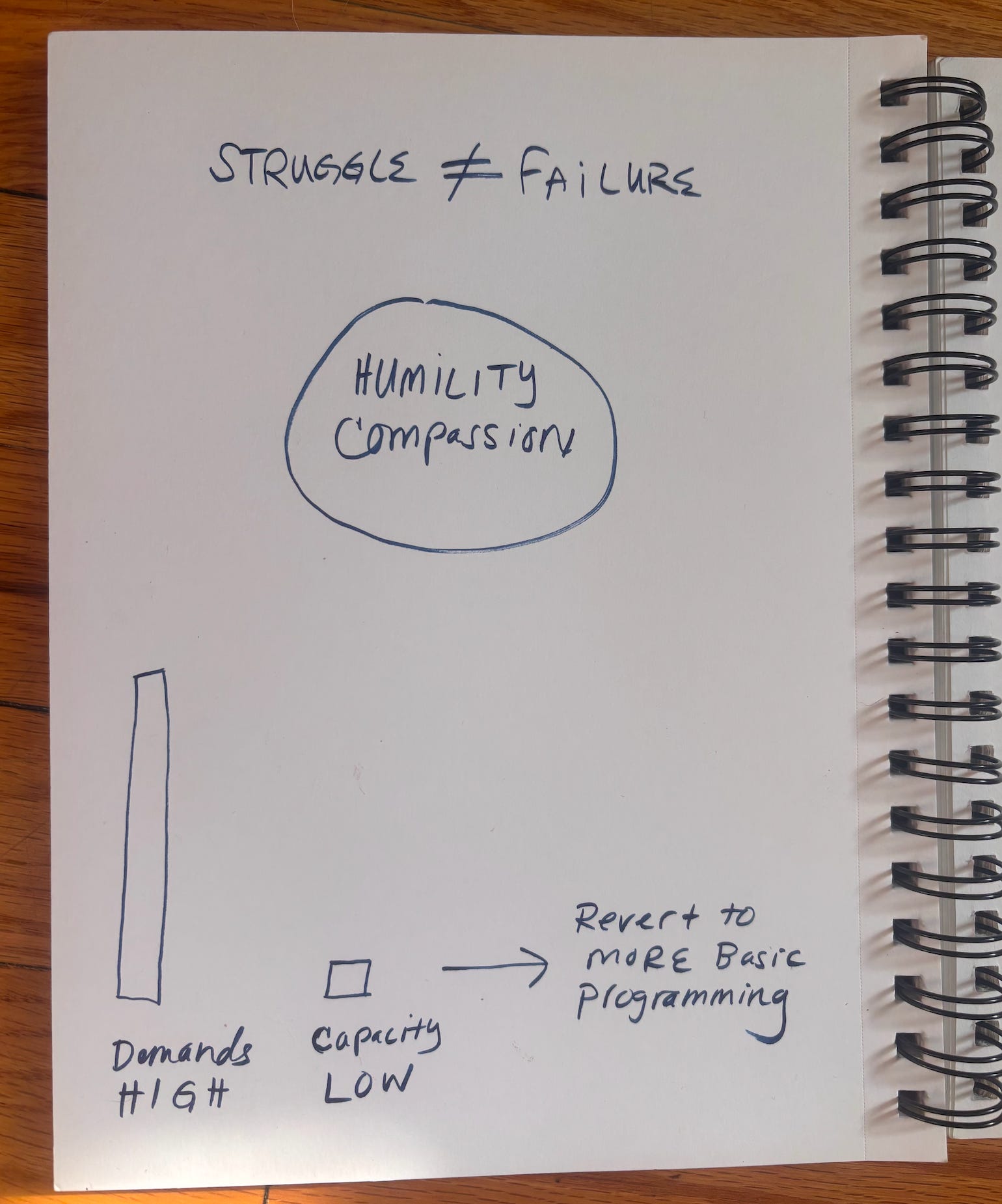
I can also just remember this nervous system tendency: my demands got TOO HIGH, my capacity WENT DOWN, I reverted to my BASIC PROGRAM. Right, right right! This helps me locate where I am on the map of my nervous system. It helps me notice what I can do. It helps me notice that demands got TOO HIGH!
I need to do or not do what it takes to create more space in my nervous system, so my capacity can return.
In SE we often use the fruit bowl analogy. My capacity is my fruit bowl—how much fruit it can hold. I might be used to having a fruit bowl that can hold a few oranges, some bananas, some avocados, a variety. But if I dump a dozen apples into my fruit bowl, it’s going to spill over, it is beyond the amount it can hold. This is the thing with too many apples—sometimes you need help. Sometimes you need support.
Especially for those of us who came from homes that lacked support to explore learning how to do life with safety and freedom, getting support can be difficult and SO NECESSARY. I’m incredibly grateful to receive support in my life and to be the one to support my clients on their path to growth and healing. Sometimes it’s so supportive to just hear someone reflect back, that’s a lot of apples! Too many apples! So sorry you are bogged down by apples! You are just one person who is allowed to be self-compassionate about how many apples you can hold. It can be so healing and corrective.
For now, I hope that this nervous system map might help some of you be softer, more compassionate, more humble with yourselves. I hope we can all learn to take feedback well and grow and learn from each other. Just remember: you are not broken, your nervous system is intelligent. It adapted to what it was exposed to and it can change based on new practices. And I continue to be available for 1:1 sessions should you want support. We all deserve support!

Jaye Fishel, SEP, CMT, is a somatic therapist based in Echo Park, Los Angeles.
Since 2021, Jaye has specialized in nervous system regulation and Craniosacral Therapy, helping individuals who feel disconnected from their bodies rebuild their capacity for authentic boundary-setting and deep self-connection. Through dedicated 1:1 sessions and workshops, Jaye supports you in listening to your body, articulating your needs without guilt, and safely expanding your capacity for pleasure, rest, and relational clarity.